Ergonomics in Modern Dentistry: Top Instruments Designed to Reduce Hand Fatigue
As a dental professional, your hands are your livelihood. Yet, spending hours performing repetitive, high-precision movements in a restricted field of view takes a massive physical toll. Studies show that a staggering number of dentists and hygienists experience musculoskeletal disorders (MSDs), with carpal tunnel syndrome and tendonitis topping the list.
While posture and chair ergonomics are frequently discussed, the tools you hold for hours every day are just as critical.
Investing in ergonomically designed dental instruments isn’t just about comfort—it’s about career longevity and maintaining the highest standard of patient care. Here is what to look for when choosing instruments designed to protect your hands, wrists, and joints.
1. Handle Diameter: Bigger is Better
Using narrow, pencil-thin instruments forces your fingers into a tight “pinch grip.” Over time, this constant constriction restricts blood flow and strains the tendons in your wrist.
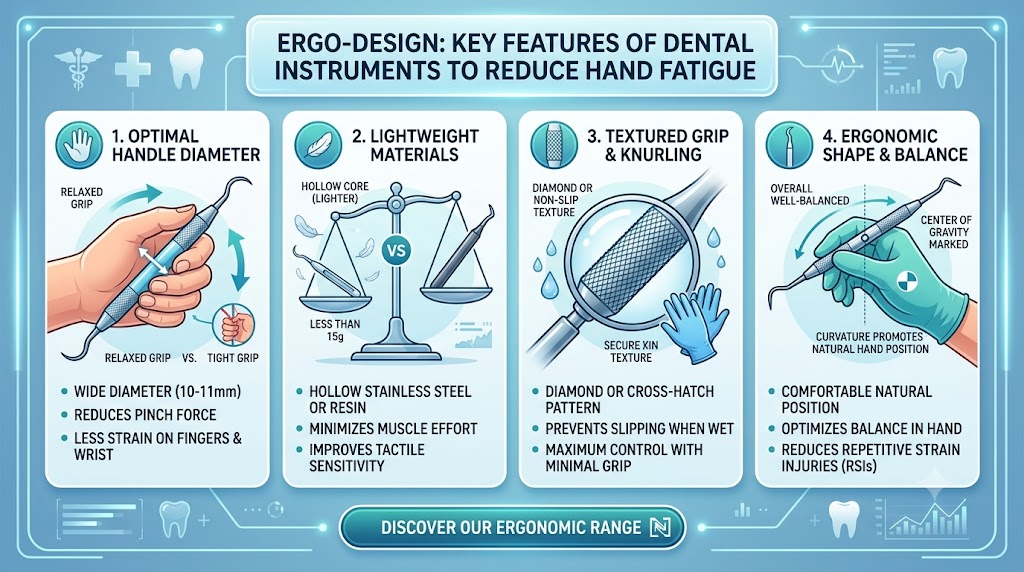
- The Ergonomic Standard: Look for instruments with a hollow core and a wider handle diameter (ideally between 10mm and 11mm).
- The Benefit: A larger handle requires less pinch force to maintain a secure grip, significantly reducing muscle fatigue during long scaling or restorative procedures.
2. Weight Distribution: The Power of Hollow Handles
Heavy, solid-steel instruments force your hand muscles to work harder just to counteract gravity and maintain control.
- The Ergonomic Standard: Opt for lightweight, hollow-core stainless steel or high-grade resin handles. The ideal ergonomic instrument should weigh less than 15 grams.
- The Benefit: A lightweight tool improves tactile sensitivity, allowing you to feel structural changes along the tooth surface without needing to press down aggressively.
3. Knurling and Texture: Maximum Control, Minimum Effort
If an instrument handle is too smooth, it becomes slippery when wet. To compensate, practitioners instinctively squeeze harder, leading to rapid hand cramping.
- The Ergonomic Standard: Look for advanced knurling patterns—the raised, diamond, or cross-hatched textures on the handle.
- The Benefit: High-quality knurling provides mechanical friction. This means the instrument stays securely in your glove with minimal gripping effort, giving you precise control even during complex extractions or deep scaling.
💡 Clinical Tip for Practice Managers
When auditing your clinic’s inventory, don’t just look at wear and tear. Ask your clinical team which instruments leave their hands feeling fatigued by 2:00 PM. Upgrading those specific kits to ergonomic alternatives can drastically improve team morale and reduce sick leave related to repetitive strain injuries.
The Long-Term Return on Investment
Choosing surgical and dental instruments shouldn’t just be a matter of upfront cost. When you factor in the physical health of your practitioners and the precision of their work, ergonomic instruments pay for themselves many times over. By reducing hand fatigue, you maintain a steady hand, work more efficiently, and protect your most valuable asset: your physical health.
Upgrade Your Operatory Today
Are your current instruments causing unnecessary strain? Explore our curated collection of Premium Lightweight & Ergonomic Dental Instruments. Featuring oversized, hollow handles and precision knurling, our range is engineered to keep your hands comfortable from the first appointment to the last.
👉 [Browse Our Ergonomic Range Now]